
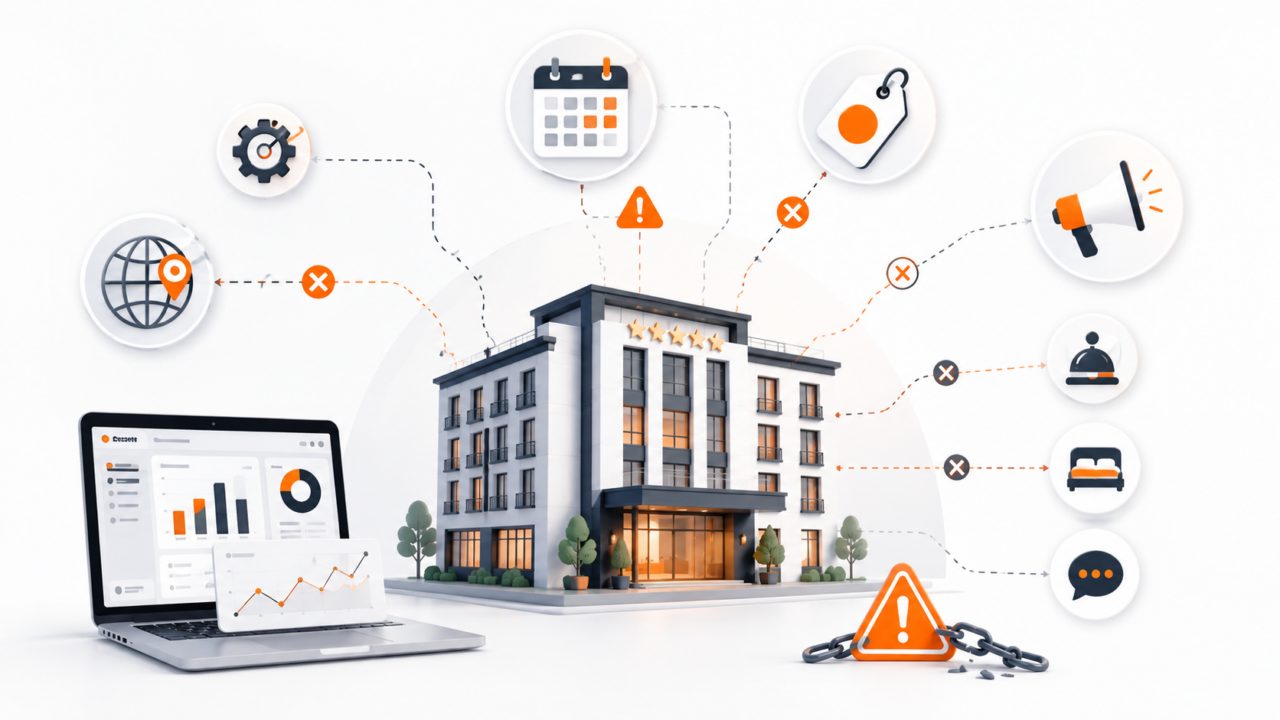
This costs revenue:
Hotel distribution is now technically easier than ever: prices are distributed via channel managers, booking channels are digitally connected, and promotions can be activated with just a few clicks. Nevertheless, many hotels still make mistakes that have a noticeable impact on reach, revenue and profit.
Often, the problem does not lie with a single system. It is because distribution is not managed consistently. Availability, rates, booking conditions, promotions and distribution costs must be considered together. Otherwise, gaps arise – and it is precisely these gaps that cost money.
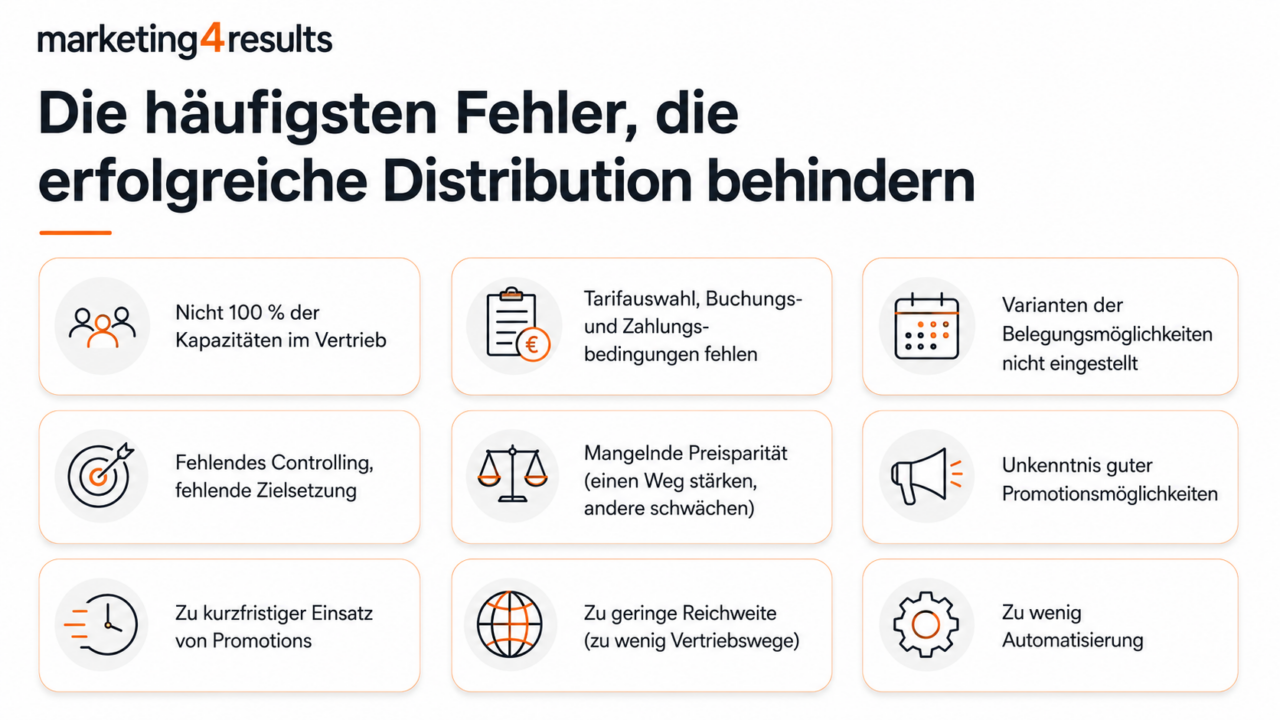
1. Not 100% of capacity is visible in sales
A common mistake: not all bookable capacity is actually visible in sales.
This applies to rooms, extra beds, family bookings, apartments, suites, function rooms and special accommodation options. If capacity is not properly set up in the system or cannot be booked via the relevant channels, this results in unnecessary loss of revenue. This becomes particularly critical during periods of high demand. In such cases, it is not necessarily guests that are lacking – but bookable offers. The rule is: during periods of high demand, prices go up, not availability down….
Check: Is all saleable capacity correctly reflected in the PMS, booking engine and channel manager?
2. Lack of rate options and booking and payment terms
Many hotels have too few clearly structured rates. Or the existing rates are difficult for guests to understand. Yet rate models have a significant influence on booking decisions. Guests want to be able to choose: flexible or cheaper, with or without breakfast, cancellable or non-cancellable, payable immediately or later.
If these options are missing, the hotel is missing out on booking potential. At the same time, the hotel lacks an important tool for managing demand and liquidity.
Useful options include, for example:
- Flexible daily rate (in hotels catering to business guests, with or without breakfast)
- Early bird rate – e.g. as a non-refundable rate
- Half-board or package rate
- Long-stay offers
- Corporate or regular guest rates
It is important to note that every rate type needs a clear purpose. Too many unmanaged rates cause confusion. Too few rates limit sales opportunities.
3. Different occupancy options are not available
A classic issue in distribution: rooms are technically bookable – but not for all reasonable occupancy options. Examples: A double room can only be booked for two people, even though single occupancy would also be possible. A family room is not configured for two adults and one child.
Extra beds, children’s rates or dogs are not properly configured. Apartments can only be booked for standard occupancy, even though other options would be possible.
This results in guests seemingly being unable to find suitable availability – even though the hotel could actually sell those rooms.
Check: Can guests book all realistic occupancy options directly online?
4. Lack of monitoring and lack of clear objectives
Distribution without monitoring is just a matter of gut feeling. Whilst many hotels track revenue and occupancy rates, they do not consistently analyse which booking channel contributes what. As a result, decisions are often made on an emotional basis: OTA commissions seem too high, Google Ads appear necessary, and direct bookings are automatically considered good.
However, the economic perspective is crucial.
Hotels should regularly analyse:
- Revenue per channel
- Nights per channel
- ADR per channel
- Cancellation rate per channel
- Distribution costs per channel
- Profit contribution per booking channel
Only in this way can it be seen which channels are truly profitable and where unnecessary costs are arising.
5. Lack of price parity
Price parity does not mean blindly charging the same price everywhere. However, the pricing logic must be transparent. It becomes problematic when individual channels are unintentionally cheaper than others. For example, when OTA discounts, mobile rates, Genius programmes, package prices or old promotions apply simultaneously. In such cases, guests may end up booking more cheaply on a third-party platform than on the hotel’s own website.
This undermines direct sales and leads to a loss of trust.
The guiding principle should be: your own website must not offer a worse deal than external booking channels. That doesn’t always mean the lowest price. It could also be a better overall package: better cancellation terms, a direct booker benefit, a little extra or more flexibility.
6. Lack of awareness of effective promotional opportunities
Promotions can be highly effective – provided they are used strategically. However, many hotels either fail to make use of promotional opportunities at all or offer discounts without a clear strategy. Both approaches are problematic.
A good promotion should always have a specific objective:
- boosting quiet periods
- encouraging longer stays
- Secure early bookings
- Generate short-term demand
- Target specific customer groups
- Support direct bookings
Not every promotion needs to involve a large discount. Often, a clear rationale for the offer, added value, a minimum stay requirement or targeted visibility are more effective than blanket price reductionswert, Mindestaufenthalt oder gezielte Sichtbarkeit wirkungsvoller als pauschale Preisnachlässe.
7. The short-term use of promotions
Many promotions are only launched once demand has already dried up. By then, the pressure is high – and so are the discounts. It is better to plan ahead. Promotions should not be seen merely as a stopgap measure, but as part of the sales strategy.
Those who identify slow periods early on can respond in a targeted manner: with appropriate offers, tailored channels, clear target groups and controlled durations.
Short-term promotions can be useful. But they should not be the norm.
8. Insufficient reach due to too few distribution channels
Direct bookings are important. But a hotel needs sufficient reach to generate demand. If you rely solely on your own website but have too little visibility there, you will lose potential guests. Those who rely solely on OTAs make themselves dependent. Those who do not use suitable specialist channels are missing out on target groups. The right channel structure depends on the type of hotel. A holiday hotel needs different distribution channels to a business hotel, a conference hotel or an apartment complex.
A balanced mix is key:
- own website
- Google Business Profile
- booking engine
- OTAs
- regional platforms
- specialist portals
- corporate clients
- MICE channels
- newsletters
- regular guests
- partnerships
However, reach must not be bought at any price. Each channel should be regularly reviewed in terms of costs and results.werden. Jeder Kanal sollte regelmäßig auf Kosten und Ergebnis geprüft werden.
9. Insufficient automation
Many distribution processes are still managed manually. This takes time, increases the error rate and makes active management more difficult.
Typical weaknesses include:
- Manual quota management (we only work with distribution partners who accept daily rates and up-to-date availability figures)
- Non-automated rate logic
- Missing or poor interfaces
- Manual quotation processes
- Unclear payment processes, lack of payment integration in the PMS
- Lack of reporting routines
Automation is no substitute for strategy. But it ensures that the strategy can be implemented effectively.
Distribution requires control, structure and clear objectives
The most common mistakes in hotel distribution do not arise because hotels lack booking channels. They arise because capacity, rates, availability, prices, promotions and processes are not managed consistently.
More sales do not automatically mean higher profits. What matters is whether the right offers are visible and bookable at the right time via the right channels.
Hotels should therefore regularly ask themselves:
- Is all capacity bookable?
- Are the rates clearly structured?
- Are all occupancy options set up correctly? (Don’t forget children’s offers!)
- Is the pricing logic correct?
- Are promotions used in a targeted manner?
- Is the reach sufficient?
- Are processes automated?
- And is success measured for each channel?
Those who answer these questions thoroughly not only improve their distribution. They improve the profitability of the entire hotel operation.